



 Редакцийн ёс зүй
 Нууцлалын бодлого
 Холбоо барих

 Онцлох
 Шинэ
Шинэ
 Тренд
Тренд
 Буцах
Буцах


The Korea Times announced the results of K-universities Global Excellence Rankings 2026, the nation’s first comprehensive assessment of global performance across its universities, on Sept. 24, 2025. The evaluation was launched to provide an objective analysis of the globalization status of Korean universities and to offer practical guidance for international students choosing institutions in South Korea.
Korea University ranked first overall, demonstrating global excellence
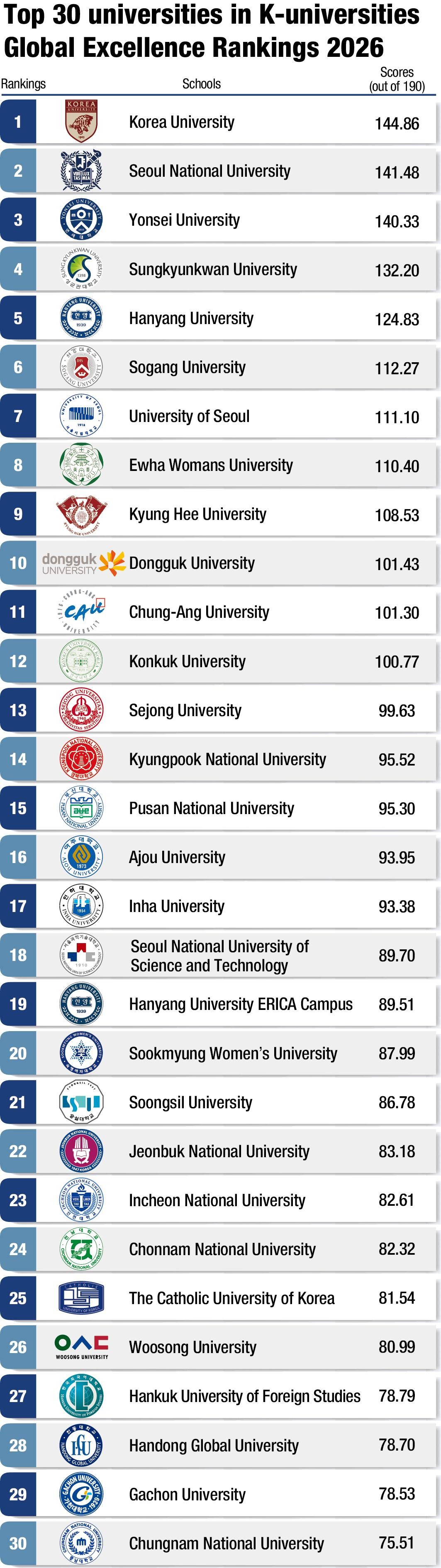
In the overall rankings, Korea University secured first place with a total score of 144.86, followed by Seoul National University (141.48) and Yonsei University (140.33). Rounding out the Top 10 were Sungkyunkwan University (132.20), Hanyang University (124.83), Sogang University (112.27), University of Seoul (111.10), Ewha Womans University (110.40), Kyung Hee University (108.53) and Dongguk University (101.43).
The Korea Times selected the Top 30 universities based on their overall scores and recognized them as “globally excellent universities.” Alongside the familiar leading universities in Seoul, the list also included major national universities such as Kyungpook National University, Pusan National University and Jeonbuk National University, as well as specialized institutions with strong globalization drives, such as Woosong University and Handong Global University.
Overview of top universities by category
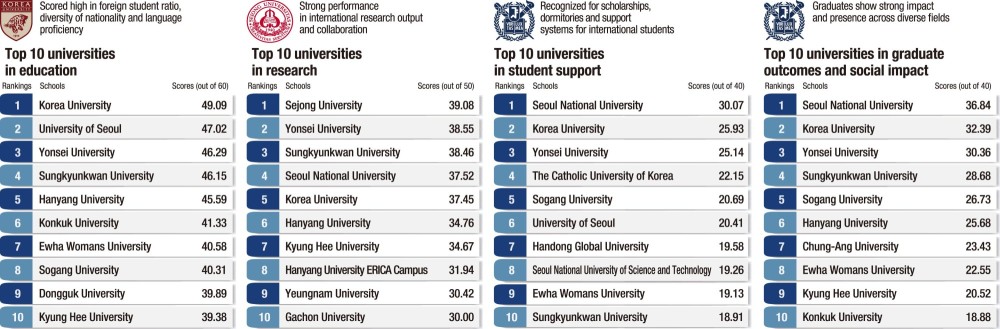
Korea University ranked first in the education category with 49.09 points, followed by the University of Seoul and Yonsei University in second and third place. In the research category, Sejong University claimed the top spot with 39.08 points, ahead of Yonsei University and Sungkyunkwan University.
Seoul National University led the student support category with 30.07 points and also earned the highest score in the graduate outcomes category at 36.84 points.
Demand growing for reliable globalization metrics as international student enrollment in South Korea surpasses 208,000
The evaluation reflects the reality that amid declining domestic student numbers and worsening university finances, attracting international students has become a crucial survival strategy for Korean universities. As of 2024, South Korea hosted more than 208,000 international students. The government has set a target of attracting 300,000 international students by 2027 under the Ministry of Education’s Study Korea 300K Project.
However, existing university rankings have largely been designed for domestic students, resulting in a lack of credible and practical information for international applicants.
Evaluation assigned 63.2% of indicators to globalization
The defining feature of K-universities Global Excellence Rankings 2026 is that 63.2 percent of its indicators focused on globalization — a far higher proportion than in other major domestic and global university rankings, including the QS World University Rankings (15 percent), THE World University Rankings (7.5 percent) and JoongAng Ilbo University Rankings (22.5 percent).
The evaluation covered 22 detailed indicators across four categories — education (60 points), research (50 points), student support (40 points) and graduate outcomes (40 points). Special emphasis was placed on measures critical for international students, including student recruitment and exchange, diversity of nationalities, retention rates, scholarships and dormitory capacity.
Evaluation conducted on 54 universities nationwide, expected to expand
The K-universities Global Excellence Rankings 2026 assessed 54 four-year universities based on international student enrollment, institutional size and regional representation. Data sources included official university disclosure statistics (as of June 2025), Naver Scholytics for research output and The Korea Times archives and public records for graduate impact.
The Korea Times expands its leadership in global higher education
Founded in 1950 as Korea’s first English-language daily, The Korea Times launched this evaluation to enhance the global competitiveness of Korean universities. The newspaper announced plans to expand the scope of future evaluations, incorporating qualitative measures such as surveys of international faculty and students.
In addition, The Korea Times will work with the Ministry of Education and other institutions to expand disclosure of key indicators not currently included in official databases, such as the percentage of courses taught in English, education costs for international students and employment outcomes.
The results of this evaluation are expected to provide valuable insights for international students preparing for admission to Korean universities in the 2026 academic year.
According to Korean Educational Development Institute, as of 2024, South Korea hosts approximately 208,962 international students,with Mongolian students accounting for the third-largest group at 12,317.
Annual Figures of Mongolian Students
2018 : 6,768 (4.8% of the total)
2019 : 7,381 (4.6% of the total)
2020 : 6,842 (4.5% of the total)
2021 : 6,028 (4.0% of the total)
2022 : 7,348 (4.4% of the total)
2023 : 10,375 (5.7% of the total)
2024 : 12,317 (5.9% of the total)
The Korea Times announced the results of K-universities Global Excellence Rankings 2026, the nation’s first comprehensive assessment of global performance across its universities, on Sept. 24, 2025. The evaluation was launched to provide an objective analysis of the globalization status of Korean universities and to offer practical guidance for international students choosing institutions in South Korea.
Korea University ranked first overall, demonstrating global excellence
In the overall rankings, Korea University secured first place with a total score of 144.86, followed by Seoul National University (141.48) and Yonsei University (140.33). Rounding out the Top 10 were Sungkyunkwan University (132.20), Hanyang University (124.83), Sogang University (112.27), University of Seoul (111.10), Ewha Womans University (110.40), Kyung Hee University (108.53) and Dongguk University (101.43).
The Korea Times selected the Top 30 universities based on their overall scores and recognized them as “globally excellent universities.” Alongside the familiar leading universities in Seoul, the list also included major national universities such as Kyungpook National University, Pusan National University and Jeonbuk National University, as well as specialized institutions with strong globalization drives, such as Woosong University and Handong Global University.
Overview of top universities by category
Korea University ranked first in the education category with 49.09 points, followed by the University of Seoul and Yonsei University in second and third place. In the research category, Sejong University claimed the top spot with 39.08 points, ahead of Yonsei University and Sungkyunkwan University.
Seoul National University led the student support category with 30.07 points and also earned the highest score in the graduate outcomes category at 36.84 points.
Demand growing for reliable globalization metrics as international student enrollment in South Korea surpasses 208,000
The evaluation reflects the reality that amid declining domestic student numbers and worsening university finances, attracting international students has become a crucial survival strategy for Korean universities. As of 2024, South Korea hosted more than 208,000 international students. The government has set a target of attracting 300,000 international students by 2027 under the Ministry of Education’s Study Korea 300K Project.
However, existing university rankings have largely been designed for domestic students, resulting in a lack of credible and practical information for international applicants.
Evaluation assigned 63.2% of indicators to globalization
The defining feature of K-universities Global Excellence Rankings 2026 is that 63.2 percent of its indicators focused on globalization — a far higher proportion than in other major domestic and global university rankings, including the QS World University Rankings (15 percent), THE World University Rankings (7.5 percent) and JoongAng Ilbo University Rankings (22.5 percent).
The evaluation covered 22 detailed indicators across four categories — education (60 points), research (50 points), student support (40 points) and graduate outcomes (40 points). Special emphasis was placed on measures critical for international students, including student recruitment and exchange, diversity of nationalities, retention rates, scholarships and dormitory capacity.
Evaluation conducted on 54 universities nationwide, expected to expand
The K-universities Global Excellence Rankings 2026 assessed 54 four-year universities based on international student enrollment, institutional size and regional representation. Data sources included official university disclosure statistics (as of June 2025), Naver Scholytics for research output and The Korea Times archives and public records for graduate impact.
The Korea Times expands its leadership in global higher education
Founded in 1950 as Korea’s first English-language daily, The Korea Times launched this evaluation to enhance the global competitiveness of Korean universities. The newspaper announced plans to expand the scope of future evaluations, incorporating qualitative measures such as surveys of international faculty and students.
In addition, The Korea Times will work with the Ministry of Education and other institutions to expand disclosure of key indicators not currently included in official databases, such as the percentage of courses taught in English, education costs for international students and employment outcomes.
The results of this evaluation are expected to provide valuable insights for international students preparing for admission to Korean universities in the 2026 academic year.
According to Korean Educational Development Institute, as of 2024, South Korea hosts approximately 208,962 international students,with Mongolian students accounting for the third-largest group at 12,317.
Annual Figures of Mongolian Students
2018 : 6,768 (4.8% of the total)
2019 : 7,381 (4.6% of the total)
2020 : 6,842 (4.5% of the total)
2021 : 6,028 (4.0% of the total)
2022 : 7,348 (4.4% of the total)
2023 : 10,375 (5.7% of the total)
2024 : 12,317 (5.9% of the total)